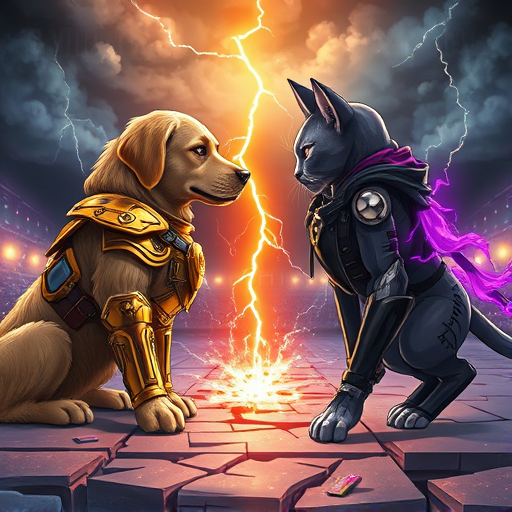
GAME FACTORY TEST — pet-based CCG development
This is the second game out of the SparkOne game factory, and it exists to test the factory rather than the other way round. The governing rule is standard first, platform second: build one real thing and write down honestly what broke, build a second one different enough to disprove the first’s accidents, then derive the standard by union. Wasteland Wrecker 3D was the first — a 3D action game. PetWars is the deliberate opposite: a 2D collectible card game, chosen because almost nothing it needs is what an arena shooter needs.
What survives in both is the standard. What only worked in one was an accident of that game, and got thrown away.
Five dynasties. One pen. No mercy.
They have trained their whole lives for this. Five rival shops. Five schools of war. One hundred and forty-eight combatants, each honed to a single terrible purpose, and every one of them absolutely certain they are about to win. Choose your dynasty. Assemble twenty-five. Step into the pen and settle it.

- THE KENNEL. Overwhelming force, applied early and without apology. They do not out-think you. They arrive in numbers, buff as one body, and close the door before you have finished your opening. Throw the Ball is not a toy — it is a command, and something is going to be caught.
- THE CATTERY. Surgical. Contemptuous. A chain of cheap cards executed faster than you can respond, and then Distraction — and the guardian you spent four turns building simply goes to sleep, and the road behind it is open.
- THE AVIARY. Air supremacy. Your wall means nothing. Every guard you assemble, every body you place in the way, is furniture to something with Flight — they go over the problem, and they were never going to fight you on the ground.
- THE AQUARIUM. The long game, played from behind glass by something that has already read yours. Bubble up. Nap the threat. Out-value you across twenty turns and let you work out, somewhere around turn fourteen, that it has been over for a while.
- THE TERRARIUM. Attrition as doctrine. Venom means the trade is never even. Shed means they walk away from the trade they just won. Under the heat lamp, they are not waiting — they are deciding.

Nothing gets past the pen. You cannot reach a rival shop while anything still stands in front of it. No skipping the board, no reaching over it, no winning the game without going through what your opponent put in your way. Guards force the issue. Flight ignores the wall entirely. A sleeping pet stops blocking — and every one of those exemptions is something the card already told you it would do. Read the cards. They do not bluff.
Treats are the resource, and they grow every turn, so the plan you could not afford on turn three arrives on turn six carrying everything it has been saving up for. 148 cards. 53 items any dynasty can wield. Two copies maximum, twenty-five to a deck, and no second chances inside a match.
An economy that cannot dead-end. Win for 15 coins, lose for 2 — defeat still pays, because a collection game that punishes losing is a collection game nobody finishes. Packs cost 100 and hold five: four commons and one guaranteed rare or better, epic roughly 1 pack in 10, legendary 1 in 25. Own two copies of a card and it leaves the pull pool permanently — so packs get better as your collection fills, never worse, and an exhausted pool pays coins instead. A pack is never a trap purchase.
And now they can come for each other.
PvP is live. Host a match, send the lobby to somebody who has wronged you, and settle it with an actual person instead of an algorithm. Same 148 cards. Same pen. Same rule that nothing gets past a body standing in front of it. The difference is that the thing on the other side of the board can now be disappointed in you personally.
You need an account — matches are relayed through the server, so both shops have to exist somewhere other than your own browser. Everything else is unchanged: your collection, your decks, your coins. Bring the deck you already trust.
(It is a game about a pet shop. Nobody is hurt, everybody goes home, and the soundtrack is extremely cheerful. The war is entirely in their heads. That is the joke, and they are not in on it.)
What the test was actually measuring
A rules engine with no clock, no DOM and no randomness of its own. The simulation is a pure core: same seed, same match, every time. That is not purity for its own sake — it is what makes the game testable without a browser, and the headless suite that falls out of it is the project’s actual definition of done. It currently stands at 821 assertions and has to be green before anything is published.
And then the purity paid a dividend nobody designed it for. That deterministic core was built for testing — a game you can run without a browser is a game you can assert 821 things about in two seconds. But a simulation that is a total function of its inputs is also a simulation two computers can run in agreement, which is most of what multiplayer is. So PvP does not have a server that plays the game. It has a server that keeps an ordered list of moves, and both players’ browsers replay that list through the same engine. Each step is fingerprinted and compared, so if the two ever disagree the match stops and says so rather than quietly becoming two different games.
The alternative would have been reimplementing 148 cards, 13 keywords and a 20-operation effect DSL in PHP — a second rules engine, which is really a second set of rules that agrees with the first only until it doesn’t. The constraint that made the game testable is the same constraint that made it networkable. That is the sort of thing a standard is for, and it is the most useful result this test produced.
Cards are data, never code. Every card is a list of operations drawn from a closed vocabulary, checked by a linter that rejects an invented keyword or a card whose text claims something its rules do not do. A card game is the honest stress test for that idea, because 148 cards will find the gap in a rules DSL that six vehicles never would.
Assets are declared, not scripted. One manifest lists what the game needs; a single forge renders it across five lanes — art, music, sound effects, voice and meshes — all generated on our own hardware, with GPU work queued through an admission gateway so a render never fights a training run for the card. Nothing here was drawn, recorded or bought. The card art, the music, the sound effects, the shopkeepers’ voices and the extremely serious poster at the top of this page are all outputs of that pipeline.
Both games are live, both were built to the same standard, and the standard exists because they disagreed often enough to be worth reconciling. Play it on a phone; that is what it was built for first.