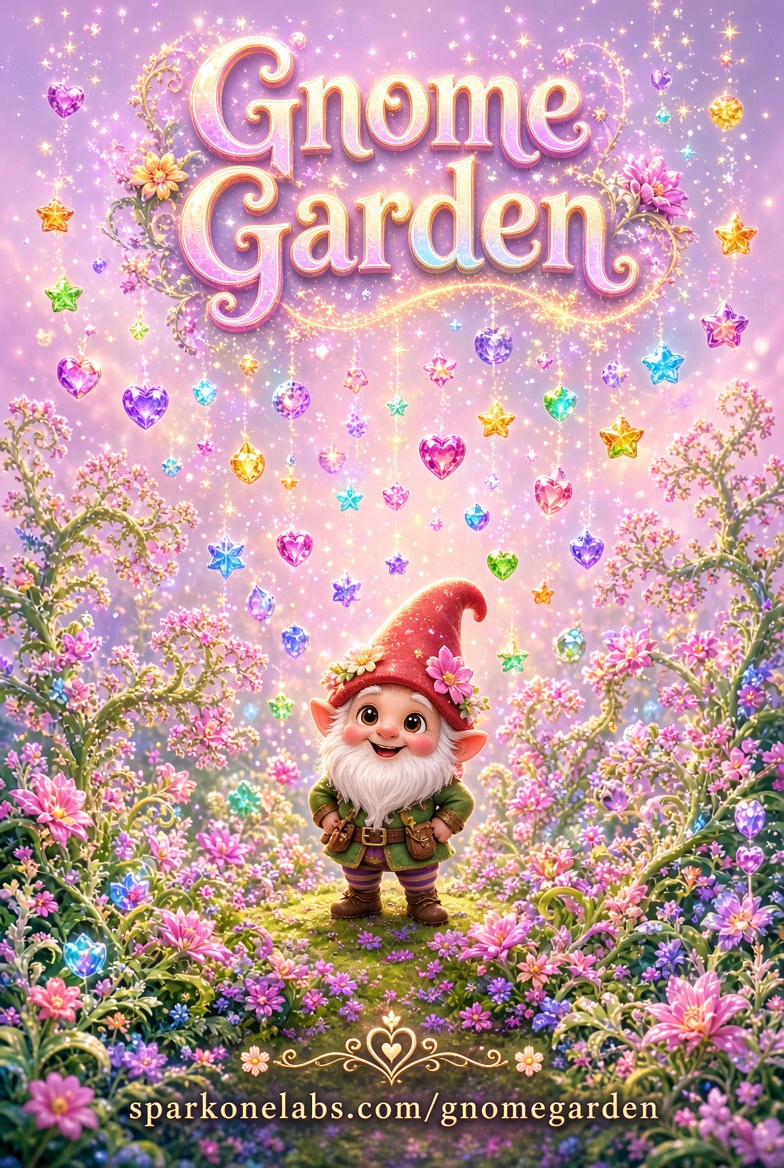
Gnome Garden — a match-3 where nothing ever goes wrong

Play it now → sparkonelabs.com/gnomegarden
You are a gnome — a Wizard or an Enchantress — from one of four kingdoms. Above your garden floats a board of glowing charms. Matching them rains light down onto the soil, and things grow. The garden grows back into the board: a plant that reaches full bloom sends a Garden Sprite up to help you, and a harvest showers the whole board with wonders.
It runs in a phone browser. It is free, it has no account requirement, and it never asks you for anything.
The rule the whole game is built on
Nothing bad ever happens in this game, to anyone, ever.
That is a design constraint with teeth, not a marketing line. Concretely it means:
- No lives. No energy. No timers. No streaks. Retry is instant and free, always.
- No failure. When a level ends without its goal, that is not a loss — the sun set on that patch, everybody went home warm, and you may potter about there again immediately. There is always a gift.
- No store, no gems, no ads. There is nothing to buy. There never will be.
- No enemies and no opponents. Every other character in the game is helpful.
The banned-word list is enforced by the build. smoke.mjs greps every shipped string — and the codebase’s own identifiers — for lose, fail, die, enemy, attack, damage, bomb, blast, danger, hurt and about a dozen more, and fails the build on a hit. The three-by-three special is a beehive. The line special is a lantern. Nothing in this game is a bomb, not even internally.
If a change would make the game meaner in exchange for being more addictive, the change is wrong.
The garden is a second board
Most match-3 games have a board and a decorative frame. Here the frame plays.
The garden sits below the board with one plot per column, and every charm you clear in column x feeds the plant in plot x. Each species favours one of the six charms and grows twice as fast on it. So a player who never looks down still wins — and a player who reads the garden wins beautifully. That gap is the whole design.
The loop closes in both directions:
| the plant reaches | and the board gets |
| Sprout | a puff of green motes, and points |
| Bud | one charm on the board turns into that plant’s favourite |
| Bloom | a Garden Sprite spawns in that column |
| Radiant | harvest — fireworks, a Codex entry, and three random charms become wonders |
So every match pays twice, on two timescales. And the gnome is down there the whole time — whistling, hoeing, running to water whichever plot is closest to blooming, chasing a butterfly when you free one, dancing at a harvest, and napping if you leave him alone for a minute.
What is in it
- 120 levels across 8 groves, each grove introducing exactly one new idea
- Four kingdoms — Mosswick Hollow, Sunmeadow Reach, Frostpetal Vale, Emberbell Glade — each a
palette, a passive trait, an active Charm and a plant family
- 48 plant species to discover, each with a written Codex entry
- 84 cosmetics and 16 critter companions
- Endless Meadow (no fail, one score, a leaderboard) and Moonlight Garden (zen, no score at
all, for when you want company rather than a challenge)
- Nine ways to combine two wonders, including one that clears the entire board
Everything in it was made on one desktop
No stock art, no asset store, no sample packs.
- 270 images generated with FLUX.1-schnell (Apache-2.0, commercial-safe) on a single
TITAN RTX, about three and a half hours behind a GPU admission gateway that queues jobs so two projects can render at once without either failing. Every asset records its model, seed, prompt and sha256 in a shipped manifest, so provenance is checkable years later instead of remembered.
- 12 music tracks and 34 sound effects synthesised from first principles with Csound — no
samples, no soundfonts, no licensing question. The title theme is in Lydian because the raised fourth is the storybook interval; it was re-rolled three times because the loop seam was audible on the wrap, which a gate measured rather than a person noticed.
- The game is fully playable with every generated file deleted. That is a tested contract:
the build physically moves the art directory aside, re-runs the entire assertion suite, and puts it back. Every sprite has a hand-drawn vector fallback, so the game is not merely functional without art — it is still pretty.
A note on how it was built
Gnome Garden is the third game from the SparkOne game factory, after Wasteland Arena and PetWars, and it is built to the same five invariants: a pure simulation with no clock and no randomness outside a seeded generator, content as plain data, a headless self-test as the definition of done, assertions that derive their expected values from the tables they guard, and proved graceful degradation.
Those invariants earned their keep here. The test suite and a measurement pass turned up, among others: a special piece that could never spawn because its shape test ran second (zero occurrences across 2.1 million exhaustive patterns); a garden that needed 130 moves to produce its first harvest in levels that grant thirty; a refill routine that permanently starved every cell beneath a blocker; star thresholds off by up to 60× because scoring is wildly non-linear in the number of charm types; and an experience curve that demanded 15.6× more points than the entire game contains.
Every one of those was invisible to a passing test suite, because in each case the wrong thing still looked exactly like the right thing happening.
And the single best bug was found by a screenshot. A CSS rule that sizes the play field pointed at a selector nothing in the document matches, so the canvas fell back to its intrinsic 300×150 default and the board drew at an eleven-pixel cell in the top fifth of the screen. Every assertion was green. Nothing overflowed — it under-flowed, and there is no test for a game that draws itself too small. Somebody has to look at the picture.
Free, no account, phone or desktop. Nothing to buy, nothing to lose.