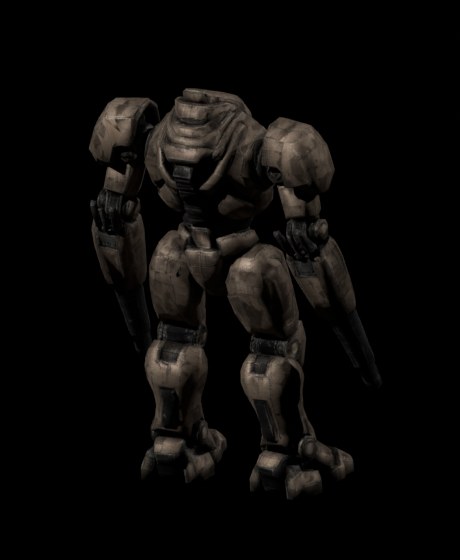
Sheet to Steel: How Our Robots Get Their Bodies
Every machine in Wasteland Arena starts as a drawing: a painted turnaround sheet and a wireframe pass that declares every panel the design owns. For the past cycle we’ve been building the road from those drawings to playable 3D — and this week the road got dramatically shorter.
Two ways to read a drawing
We had two working answers to “turn this sheet into a mesh.” The facet method reads the wireframe like stained glass: every drawn cell becomes a welded polygon, the painted sheet becomes its texture, and a measured relief makes light fall the way the artist shaded it. The generative method hands one painted panel to an image-to-3D model and gets real volume back. Neither is enough alone — and the comparison below is why. Top: the sheet. Middle: the facet build (every drawn plate preserved, but flat). Bottom: the generated mesh (true volume, detail smoothed away).

The generators grew up fast
We benched three image-to-3D models on the same assault robot sheet. TripoSR gives a mesh in about a minute; its silhouettes score around 0.6–0.7 against the drawn views. The new tier — TRELLIS.2 and Pixal3D — lands near 0.87–0.92 on the drawn silhouette from a single painted panel, with a million triangles of surface detail. An interesting split emerged: TRELLIS.2 is truer to the overall form, while Pixal3D captures finer surface detail. We use both, per job.

Every generation gets scored the same way: re-render the mesh from the sheet’s own three viewpoints and measure the silhouette overlap, view by view. Which taught us things no eyeball would have caught — for instance, that conditioning on the back panel of a turnaround beats the side panel by a wide margin, and that a top-down view is the one panel you should never condition a vehicle on.

A million triangles is not a game asset
Generated meshes arrive at ~1M triangles with seams split along every UV island — and it turns out most ways of slimming them tear them apart. We ran a methodical study: every reduction method we could get our hands on, across parameter ranges, all from one source mesh, all rendered with backface culling on so holes and flipped surfaces show up as wounds. Every pane carries its triangle count, its hole count, and a grade.

The findings, in three lines: naive decimation on a seam-split mesh opens 20,000+ real holes (that black tattered pane earned its F). Aggressive quadric simplification below 10k triangles shreds windings and degrades UVs — below that budget, detail has to move into baked maps, not geometry. And the boring-sounding winner: weld the seams first, then collapse to ~50k — textures intact, topology at source level, twenty times lighter.
The pipeline, today
Painted panel → Pixal3D → weld → collapse to 50k → census gate (holes and bad edges counted, not eyeballed) → Blender-ready file with everything packed. Here’s the GRAVEWARDEN mech through the full line:

The whole stock — every sheet with a wireframe pass, including a brand-new heavy assault robot type — is going through this line right now. Next on the bench: baking detail into normal maps so game budgets drop another order of magnitude, and a crease-detector that snaps generated surfaces to the exact panel lines the artist drew.
Update: we were only showing it one drawing
Every mech on this page was built from a single picture. The artist draws three views —
front, side, back — and the machine that turns drawings into geometry was being handed the front one
and nothing else. It guessed the rest. It is very good at guessing, which is exactly why nobody noticed.
Then we read the manual properly. One of the two models we use ships a second front door we had never
opened: instead of one photo and a guess about where the camera was, it takes several pictures
plus the exact angle each was taken from. Our sheets have always been that. We were throwing two thirds of
every one of them away.

Bottom: rebuilt from all three. Textures stripped so you are looking at shape, not paint.
Look at the back column. That is the only place the two machines were asked different
questions, because it is the only view one of them had never seen. Given only a front, the model builds a
back that is essentially the front again — same shoulder pods, carried around the other side, tidy and
confident and invented. Given the actual back drawing, it builds the spine the artist drew instead.
The honest part: this is not a clean win. The three-view mech has rougher geometry — about
thirty percent more little holes in its surface and twice as many places where the mesh folds back on itself.
So one method gives us a shape that is more true and needs more cleaning, and the other gives us a tidier
shape that is partly fiction. For a machine the player walks around, we will take true and dirty. For one
glimpsed at distance, tidy may win. That is a choice we can now make deliberately, which is the actual
upgrade.
One more thing worth writing down, because it nearly cost us a week. The other model looks like it
supports this too — the code accepts a list of pictures, and if you hand it three it runs without
complaining. It is a trap. Those weights were trained on exactly one view, and the part of the code that
reads camera angles opens the file, takes the number of images, and throws the angles away. It would have
produced something confident and wrong, and we would have believed it, because it renders just fine. We
found that by measuring rather than by trusting that running means working.
Still a work in progress, and the pipeline moves most weeks.
The arena is live if you want to see what these machines do to each other.
2 thoughts on “Sheet to Steel: How Our Robots Get Their Bodies”